Archive for the 'Strategies' Category

For the Tenants: How to Deal with Noisy Neighbors

Thursday, April 23rd, 2009

You’re living in a nice apartment, but you have really noisy neighbors.  You have been trying to deal with it, but you’re at the point where you feel you cannot put up with it any longer. What do you do?

I recently spoke about this with Rob Sachs at NPR, and I thought it would help to elaborate.

Step 0: Take Notes

Keep a detailed record of every incident and communication related to the noisy neighbors.  Record what happened, when it happened, who was involved, who else saw/heard/etc.  In general, this is a good rule of thumb whenever you’re having trouble with another party, whether it’s a tenant, landlord, noisy neighbor, or somebody else.  It will allow you to remember the details and help you refute inaccurate claims if things get nasty.

Step 1: Talk to Your Neighbors

Your first step should be to talk with your neighbors.  It is important to let them know that you are bothered by their noise.  They may not realize that they are being loud, and they cannot do anything unless they know about the problem.

You should approach them in a calm and friendly way while the noise is going on.  Do not be confrontational, but be clear in describing how the noise is affecting you.  You won’t be perceived as being nasty or unfriendly as long as you are nice, calm, and neighborly.

Assume  that they are reasonable people and that they are not aware they are being loud.

Step 2: Talk with Your Landlord

Do not approach your landlord until you have tried talking to the neighbors at least two times.   You should only approach the landlord after the neighbors have demonstrated a complete lack of regard for you and your sanity, when there have been several incidents with no sign of stopping.

When you speak with your landlord, start of by describing that you have unsuccessfully tried to deal with the situation yourself.  List the incidents from your record, and describe the conversations that you’ve had.  Not all landlords are going to deal with the noise, but  you won’t know until you try.

Also, encourage other neighbors to contact the landlord if they are bothered too.

Now, I am a landlord (obviously) and I know that some landlords will be mad at me for giving this advice.  My reason is as follows:  while, as a landlord, I would prefer not to be bothered, I also want my tenants to be happy and to continue renting from me.  If they have a problem, and have been diligent yet unsuccessful in solving it, I want to do what I can to help them.  If I can help them fix a problem, especially if it would prevent them from moving out, then I am happy to help.

Step 3: Call the Police

That being said, the landlord may be unable or unwilling to help.  At this point, you have explored all of the options available, so the next thing to do is to call the police.  It is important that you call the police while the noise is still going on.  You will lose credibility if they show up and the only audible sound are birds chirping peacefully in the back yard.

Talk with the police offers when they arrive.  Ask them what options you have, and see what they recommend.  Laws and ordinances change depending on your location, but they should know what options you have.

Also, it is important to remember that once the police are involved you will no longer have a good relationship with your neighbors.  Bringing the police in may encourage the neighbors to increase the volume or retaliate in other ways.

Step 4: Speak with a Lawyer

Depending on the local laws and regulations, you may have civil recourse.  A judge cannot silence your neighbor, but he may be able to impose fines which you will receive.  Again, this varies widely by town, so a local lawyer could give the most specific advice.

If you’re ambitious and confident, you can explore the law yourself and potentially take the noisy neighbors to small claims court pro se.

What not to do!

There are several things that you should not do throughout this process, because they will be counterproductive to your goal.

  • DO NOT fight fire with fire.  Do not start blasting loud music to retaliate.  This will only encourage them and mutually assured destruction will ensue.
  • DO NOT be nasty to the neighbors at any point.  Always try to be friendly, even when you’re explaining how they’re ruining your life.
  • DO NOT call the police or the landlord unless they would agree that the noise is excessively loud.  If you are complaining about your neighbors breathing, then you are going to lose all sympathy.
  • DO NOT permanently change your apartment without your landlord’s written approval.  This includes new walls,  permanent soundproofing, or anything which is permanent or in violation of your lease.

What else can you do?

There are a few other options of things you can do if the noise doesn’t stop

  • Rearrange the furniture in your apartment, sometimes this can help damper the noise.
  • Be understanding, if the noise is a new infant, then try to understand that parents probably have it worse than you.  At some point, you may have your own child who will keep the neighbors up at night.
  • Move = (

[image courtesy of ms4jah]

Moral Hazards

Sunday, July 27th, 2008

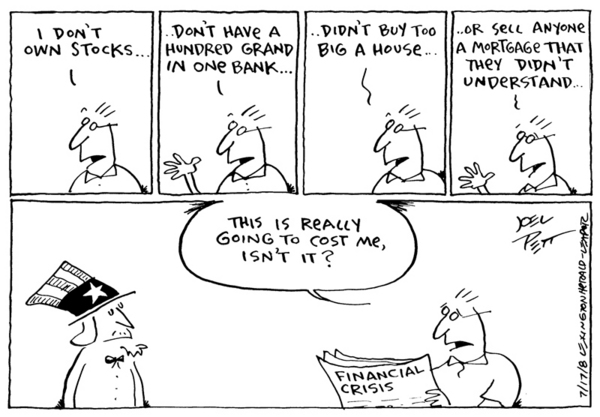
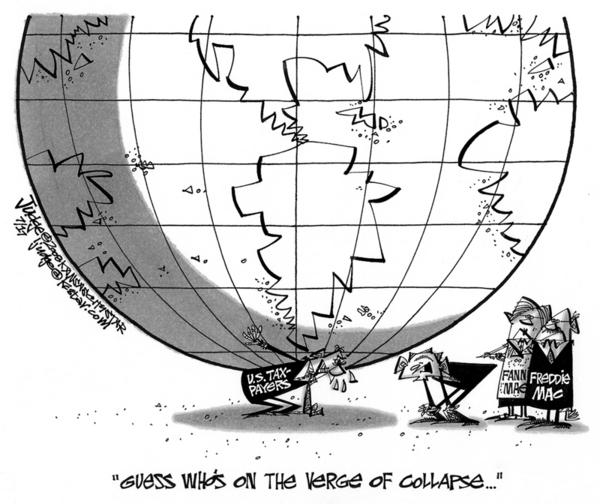
There is a great guest post about Moral Hazards on Infectious Greed written by Tom Vanderwell.  It starts off with two comics:

In the post Tom describes the dangers of government bailouts and government protections for investors.  If investors do not bear the full risk of their investments, then they will make moves that they wouldn’t otherwise make (the Moral Hazzard).  This leads to various undesirable outcomes, because in the end somebody has to pay when the losses accrue.

I strongly support some of the suggestions that Tom makes, and believe that the US government should do as little of possible (with the one exception of preventing a larger market collapse).  The notion of privatizing the gains and nationalizing the losses, for example what this $25 billion dollar bailout of Freddie and Fannie would be, goes against everything our country stands for.

More inline with the first comic above, I’ve mentioned before that all of my mortgages were all done in a very sustainable way.  They’re almost all fixed mortgages, which ironically enough I took out against the recommendations of both my mortgage brokers and realtors at the time.  If I had taken their advice, and was in bad shape now, I wouldn’t deserve any government help.  But, if those who get in trouble because they chose the less-prudent, shinier path get bailed out,  I may be more likely to take the riskier approach next time.

Hey, why lose out on some extra profits a second time?

Do you do business with family?

Friday, July 13th, 2007

I have a question out there for Shmandlord readers: Are there certain types of business that you won’t do with family members because of the potential conflicts of interest? For example, if your relative was a mortgage broker, real estate agent, or a lawyer, would you use them? If you do, are you able to keep it objective and non-personal? If you don’t, why don’t you?

For certain types of transactions, dealing with family is fine. For example, if your brother has access to wholesale prices on goods that you want to buy, not much can go wrong. Other jobs seem more conducive to problems, like what if your cousin is a mortgage broker, would you go with him? What happens if you find better rates after he’s quoted you?

Does it depend on what the service is? What about real estate brokers? lawyers? doctors?

Problem Solving 101: Drown Out Tenant Protests with Marching Band

Friday, May 4th, 2007

I hadn’t thought of this technique, but maybe I could use it if ever presented with a similar situation.

A New York landlord hired a marching band to drown out the sound of his tenants protesting asbestos contamination.

Many tenants at the midtown building, owned by Kent Swig of Swig Equities, have been driven out to make room for the construction of luxury condos at the site, the New York Post reported Monday.

The tenants remaining also have complained they have been subjected to airborne asbestos by bad renovation work.

“It’s a question of health and safety … . We have four independent tests that show asbestos,” said resident Alan Kroll, who was among about two dozen protesters outside the building Sunday.

Swig decided to drown out the protesters by hiring the Steppers Marching Band, although the move mostly just drew a curious crowd.

The Department of Environmental Protection has ordered construction halted until the asbestos is cleaned up.

Thanks mshades for the image.

What do you do when your tenants are Internet TV celebrities?

Thursday, May 3rd, 2007

Depending on what news sites you read, you may be familiar with justin.tv (justin.tv blog). Since March 19th, 2007, Justin has been wearing a camera attached to his hat 24/7, and streaming the video and accompanying audio over the internet for everybody to watch. All of this has been run out of a single two bedroom apartment in San Francisco.

Many things have happened since the camera was first turned on. A viewer prank called the police and reported a stabbing in the apartment. Shortly afterwards, the police entered the apartment with guns drawn, amusing viewers around the world who were watching it live. The next day, somebody reported a fire and six firetrucks showed up, though to the viewers’ dismay it was not aired live (techcrunch).

Other problems are occurring too. Other tenants are complaining about the traffic at all hours of the night. Tenants have also complained that they were getting filmed in common areas without their permission (SF Chronicle).

All of this has obviously upset the landlords, Trinity Management Services, who operates over 50 apartment complexes in San Francisco. After searching the apartment a few times looking for lease violations, they eventually filed for eviction against justin.tv. Not only that, but they have stopped renting other apartments to applicants for simply knowing Justin.

As a landlord, I can completely understand why Trinity would want to get rid of these guys. It seems like the case should be pretty straightforward, if they’re violating the lease, causing the other tenants to complain, and disturbing the peace: kick them out.

However, then the situation got sticky for Trinity.

With all the publicity that the justin.tv team commands, websites sprung up to try to stop the eviction. Sites like Don’t Evict Justin were put up in an attempt to bring down the management company, using all tactics possible, including digging up dirt and court documents. Worse yet, it appears that a lot of Trinity’s business comes from young entrepreneurs/professionals, which means that by fighting justin.tv they may end up alienate a significant part of their tenant base.

I find it somewhat odd that these young entrepreneurs do not empathize more with their landlords and the other tenants. They are callously disrupting the lives of the other tenants as well as impacting the business of Trinity. It is sad to see that they’re taking the all-too-common “Landlords are Evil, Screw ‘Em” stance and ignoring everybody else.

My question for the Shmandlord readers is, what should Trinity do? How could a landlord protect themselves against this (although obviously the probability that it would happen to any given landlord is virtually zero)?

How beneficial is it to make extra mortgage payments each year?

Friday, December 1st, 2006

I was reading this post on Blueprint for Financial Prosperity and it brought up several thoughts which I’d like to share.

The article is about paying a mortgage bi-weekly rather than monthly, so you end up making one extra mortgage payment a year. The thought behind this is that the extra payment will drastically cut the life of the mortgage.

mortgage pic

Consider a 30-year $200k fixed 7.00% mortgage starting in December of 2006. If you make one extra payments every December, then instead of the mortgage ending in December 2036, it will end in December of 2030 (if you make two extra payments a year, it will end in March 2027).

Now, this is obviously a tremendous savings, in the case cited above the savings is almost $100k. In the case of a primary residence, people like the notion of freeing up their cashflow early, so that they can use it in other ways, like a personal safety-net or to invest elsewhere. I think in this case, the peace of mind that people get from fully owning their house is certainly valuable.

However, how does this strategy work for investment properties?

Let’s say that I’m renting an apartment out for 2k a month, but my mortgage payment is only 1k. Is it better for me to use the extra money to pay down the mortgage, or is it better to take that money and invest it elsewhere? Surely if you highly doubt that you’re not going to be able to make anything near 7%, it is better to just pay off all of your mortgages.

The point of the investment property is that it’s an investment. What if instead of paying off the mortgage, you save the excess rent until you have enough money to buy another place on which you will also have a positive cash flow (by design, of course)? You’ll then be collecting positive cash flow from two properties, which you will then use to purchase another eventually. All the while, you’re paying off the mortgages of your existing properties. Instead of keeping all of your equity tied up in one place, you’re using it to grow your investment. In 30 years, your first property will still be completely paid off, but you’ll also have other properties that are almost paid off as well.

If you use the extra money of an investment property to pay down the mortgage, in 30 years you will have one house that is paid off, 100k, plus the rent collected over the last 6 year period, but I don’t think it compares.

In the second scenario where you buy other houses with the leftover rent, there are tax advantages plus you will benefit more from appreciation.

You’re certainly leveraging yourself more in the second scenario, but I believe that it can be done in a responsible way according to your tolerance for risk. Maybe you’ll want to wait 5 years before purchasing the second property because you want to have a large safety net before investing again. As I’ve said elsewhere on this blog, it is important to make sure that you have enough money to cover problems that will arise. If after you pay a mortgage and allot a percentage to maintenance and vacancies you still have rental profits left, I believe it would be wise to save that money and invest it elsewhere.

What do you guys think?

Thanks revdancatt for the pic.

A lesson on what not to do

Monday, November 27th, 2006

foreclosureI know I’ve mentioned the blog before, but I cannot stop reading I am Facing Foreclosure. Just for the quick overview, Casey (the blogger) bought 8 properties to flip (not rent) with a combined value of over $2 mil. He did this by taking out over $140k in credit card debt, lied on his loan applications, and put no money down. He is now suffering the consequences.

Anyway, I just wanted to post a quote from one of his blog posts that struck me as funny. I have to admit that when I first read it, I felt a hint of jealousy, but quickly snapped out of it for obvious reasons. He is toying with the notion of renting out one of the houses that is being foreclosed:

I’m not paying the mortgage so why not collect some cash, right?

You know, I really wish I could just not pay my mortgages, and pocket the rent. Wouldn’t you? He then enumerates the reason why renting is not worth it to him.

Funny. If you have any thoughts on how I can stop paying my mortgages please let me know. However, I will not consider suggestions that result in foreclosure.

Thanks sercasey for the image.

The Reverse-Millionaire

Thursday, November 2nd, 2006

It’s been over two years since I bought my first building, and since the very beginning my goal has been to accumulate as much real estate as possible. The phrase I’ve been using to describe this aspiration is to become a Reverse-Millionaire: to owe as much money to the banks, in the form of secured real-estate mortgages, as possible. The thought is, that the more money I owe the bank, the more properties I’ll own and the more money I’ll make, not necessarily in the short term, but by holding for the long term. If I can become a reverse millionaire while I’m young, in 15-20 years I’ll most likely have “boatloads of money”. There are lots of other advantages, for example, any rent inflation, becomes more money that I can pocket each month.

In order for this tactic make sense, I have a few important rules.

  1. Only buy a place when you definitely have the monthly cashflow to support it. I only want to buy a place if I know that I have the money to pay for it. I assume a 33% vacancy rate, meaning that if I receives $1,000 a month rent, count it as only +$666.67 toward cashflow to cover maintenance and vacancy costs (banks conservatively use 25% when calculating your income before giving you a mortgage).
  2. Only use 30-year fixed mortgages. Although you will have to pay a higher interest rate, this will keep the mortgage costs from spiraling out of control. After I buy a place, I know that my principle and interest payments will stay the same for the next 30 years, which is very comforting (although insurance and taxes go up).
  3. Do not lie on the applications. This should be obvious, but it isn’t always as you’ll see shortly. When a bank gives you a mortgage, they’re betting based on the information that you gave them that you are going to pay the loan back. They use the information on the application to determine how likely it is that you will default. If they are willing to give you a loan based on an honest application, then they believe that they won’t, within a tolerable level of risk, lose money. There are reasons for the checks and balances that the bank uses, when you lie you’re much more likely to get yourself in over your head.

Now, using this method I’ve purchased four properties in the last two years. I am not quite the reverse millionaire that I want to be, but I’m about two-thirds of the way there. Because I followed the rules listed above, I am in fine financial shape. If interest rates go to 500% tomorrow, that’s fine for me because I will be paying the same amount for the next 30 years. If a tenant doesn’t pay rent for a few months (as regular Landlord Shmandlord readers are aware does occasionally happen), then I can handle it.

The key point that I want to make is that, if I didn’t follow something similar to the above guidelines, it would have been very easy for me to achieve my goal of becoming a reverse millionaire by now. For example, I could have selected much riskier loans, like the infamous interest-only ones. Or I could buy more places from sellers that are in kahoots with shady mortgage brokers, which appear to be able to offer loans regardless of credit scores. The problem is, if I did these things the entire house of cards would be much more unstable than it is now.

Not everybody has been as careful. Case in point: Casey at I am Facing Forclosure dot com. This guy racked up 2.2 mil in debt (including 140k in unsecured credit card debt). Now, as you’ll see very quickly on his blog, he’s in trouble. I stumbled upon his blog on I Will Teach You To Be Rich, where oddly enough Ramit knew Casey from high school and gives some insight into Casey’s character:

Casey had tried to sucker people into a scam real-estate deal less than a week before he admitted he was going through foreclosure. I was fortunate enough to recognize his pitch as bulls**t, but what if someone had gotten conned into it? Financial scams on unsuspecting people make me furious. So I read through his site. It turns out that he had bought multiple houses in different states (hoping to flip them quickly), lied on his applications to get his loans approved, and had grossly miscalculated how much it would cost to renovate and flip them. Bad move. His debt is now over $2 million.

Now I don’t feel quite as bad about not being a Reverse Millionaire yet. However, I’m still confident that if I continue the course that I’m on, I’ll eventually get there in a reasonably safe way.

The Risk of Floods on a Purchase

Monday, September 4th, 2006

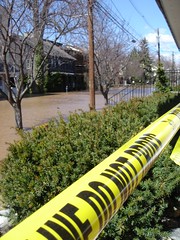
Police tapeFlooding has been in the news a lot recently, and it can (obviously) be very devastating for a real estate investor. For example, look at what happened to investors whose buildings were flooded in New Orleans due to Katrina: instantly they’re no longer collecting rents, their properties require extensive repairs, and their investments are worth significantly less than before the flood. Future investors will certainly need to factor these risks into any future purchases.

The above case is pretty easy to analyze because the risks are fairly well known. There are times when the problem isn’t so straightforward.

One such case is when flood patterns change, sometimes very unexpectedly. The Delaware River, for example, runs along the border between New Jersey and Pennsylvania. Anybody who is familiar with the Delaware and its river towns are most likely familiar with the notorious Flood of 1955, which was the worst in living memory. Afterwards, there was a long period without much flooding. Seemingly all of the sudden there have been a series of very bad floods the past few years. In fact, if you examine historical flood data, you’ll see that half of the “Major Flood Stage” crests on record occurred in 2004-2006 (For these numbers, I am using historical crest data at Riegalsville, PA. Major flood stage is 30ft.).

  1. 38.85 ft on 1955/08/20
  2. 35.90 ft on 1903/10/10
  3. 34.07 ft on 2005/04/3
  4. 33.62 ft on 2006/06/29
  5. 32.45 ft on 1936/03/19
  6. 30.95 ft on 2004/09/19

The first question that comes to mind is, why all of the sudden have there been so many floods. Proposed reasons include (source):

  • Poor management: floods could be minimized by regulating flow into and out of reservoirs that release water upstream
  • Overdevelopment and construction, both along the main stem of the river and its tributaries.
  • Bad luck. Too much rain, too quickly.

A friend of mine lives on the river in what was thought to be a 50-year flood-plain (this means that he has a 1/50 chance, or 2%, of having his house flooded in any given year). The river entered his house in each of the three floods listed above. Each time, he has had to refinish walls, replace appliances, landscape his washed-away driveway and yard, etc. His house was worth upwards of a few million dollars in 2003, and he believes that these floods could have eaten away over 30% of this value.

His flood insurance does help somewhat, however each flood still ends up costing him thousands of dollars, not to mention the hours of work preparing, evacuating, and then restoring. He personally believes that upriver construction is primarily responsible for the problem, and is interested in selling the property if he can get what he believes it is worth. He acknowledges that this will most likely require him to wait for an extended period without floods.

As an investor, how can you prepare for a situation like this? Should you simply avoid buying a place anywhere near rivers or lakes? If not, how do you prepare for the potential financial hit? How about other natural disasters, like earthquakes in California?

Personally, each of the places that I’ve purchased are in areas where it is highly unlikely that they’re going to have problems with a flood, and I am certainly comforted by this. I can appreciate how desirable water-front property is, but I believe that in order to purchase it as an investment you need to have a very large slush fund set aside (making it much less lucrative).

(Note: I took the above picture in Lambertville, NJ in April, 2005. If you would like to see more, check out this guy kayaking in his backyard, a submerged river-front shop, or an image of the Lambertville Station (there are two parking lots under there.)